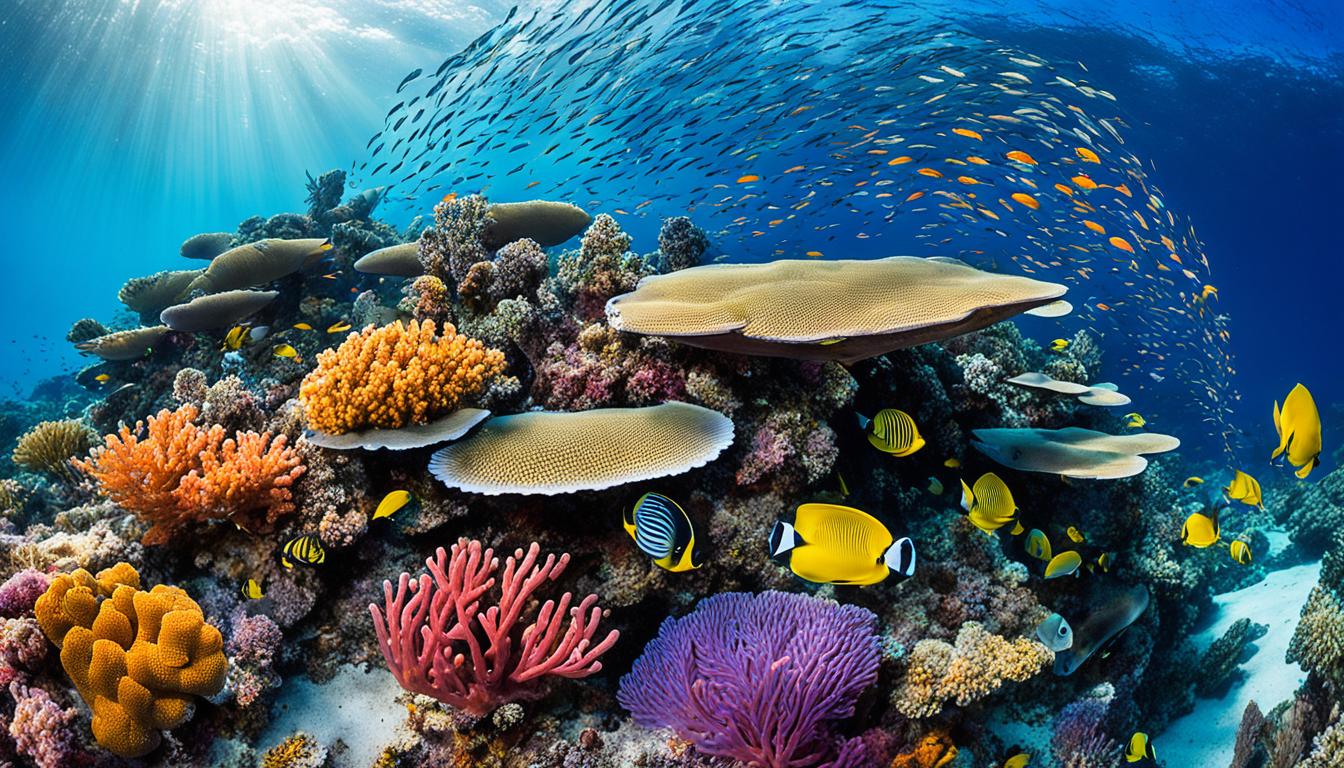
Get ready for an amazing journey into marine biology! We’ll explore the ocean’s depths and learn about ancient sea creatures. This article will share 10 interesting facts that will make you curious and appreciate the ocean more.
Let’s dive into the world of marine life and see the incredible variety of creatures. We’ll explore deep waters and find the hidden wonders living there. You’ll be amazed by how marine animals adapt and sense their surroundings.
Discover how marine life is connected and depends on each other. See the amazing journeys of sea creatures and learn about new research in marine science. This will help us protect our oceans.
Get ready to be amazed by the beauty of marine biology. Let’s explore the mysteries of the ocean together.
Unveiling the Wonders of Ocean Life
The oceans are full of life, with many species still unknown to us. From the bright surface to the deep-sea, they are full of mysteries. These mysteries are waiting for us to discover them.
Exploring Unfamiliar Depths
Under the water, there’s a huge area we don’t know much about. It’s full of different kinds of life. Scientists are learning more about the ocean’s secrets by exploring these deep places.
They’re finding out how creatures live in such tough conditions. This helps us understand how life can exist in extreme places.
Biodiversity Hotspots Beneath the Waves
Some parts of the ocean are especially rich in life. These areas are called biodiversity hotspots. They have a lot of different kinds of marine life.
These places are often near complex sea floors or where nutrients come up from the deep. You can find everything from colorful coral reefs to tall kelp forests there. It’s important to protect these areas to keep our oceans healthy.
Science: Uncovering Marine Marvels
The world of marine science is full of endless fascination. Researchers are always pushing our understanding of the ocean’s secrets. They use advanced methods to explore the ocean and make new discoveries.

With tools like ROVs and AUVs, scientists can go deep into the ocean. These machines help us learn about the strange creatures living in the dark depths. They show us how life adapts in extreme ocean conditions.
Also, ocean exploration keeps leading to amazing finds. Scientists discover new species and solve old mysteries. These discoveries help us learn more about the ocean and motivate us to protect it. This ensures a healthy future for the ocean and its life.
Ancient Survivors: Living Fossils of the Sea
Deep in the oceans, a fascinating phenomenon awaits us. Ancient aquatic species have lived for millions of years. They show us how life has changed over time. These marine living fossils give us a peek into the past, teaching us about life’s strength and flexibility.
Time-Traveling Through Evolution
The horseshoe crab has stayed the same for over 450 million years. The coelacanth, known as the “fish with limbs,” was once thought extinct. These living fossils are amazing examples of evolution. Scientists study them to learn how life has adapted in the ocean.
These discoveries make us want to learn more about life’s evolution. Researchers look into their genes and how they live. They find clues about what helps them survive through big changes in the ocean.
Exploring the ocean, we learn a lot from marine living fossils. They act like time machines, taking us back in time. They show us the incredible strength of life against change.
Bizarre Creatures from the Abyss
Step into the deep ocean’s mystery and get ready to meet some odd yet fascinating sea creatures. You’ll find bioluminescent wonders and strange beings that live in the dark depths. These creatures challenge what we think we know about life on Earth.

The vampire squid is one such oddity, looking more like an alien than a sea creature. Its black body and ghostly tentacles make it a marvel of nature. It has special features that help it survive in the deep, dark sea.
The anglerfish is another odd sea creature. It has a huge mouth and lots of teeth. It lives in extreme ocean conditions.
These creatures show us how diverse and adaptable life can be on our planet. As we learn more about the ocean’s depths, we’re likely to find even more odd and interesting sea creatures.
Symbiotic Relationships in Marine Ecosystems
The ocean is full of complex partnerships. Marine species depend on each other to survive. These relationships, known as marine symbiosis, are key to the ocean’s balance. From tiny creatures to big predators, everything is connected, making the ocean’s health and strength possible.
Nature’s Intricate Partnerships
Take the clownfish and sea anemone, for example. The clownfish lives safely among the anemone’s tentacles. In return, it keeps predators away and helps with cleaning. This helps the anemone stay healthy. It shows how different ocean creatures work together for their benefit.
Exploring the ocean reveals a world where each species depends on others. These relationships are vital for the ocean’s health. Knowing about them helps us protect the ocean and its inhabitants from harm.
Ocean’s Extreme Environments
The ocean is full of extreme conditions that test the limits of marine life. From the deep abyssal plains to the hot thermal vents and the cold polar seas, survival requires special adaptations. These environments are tough, but life finds a way.
In the deep ocean, the pressure is over 500 times what we feel on land. Creatures like the giant squid and anglerfish have evolved to live here. They can handle the pressure and find their way in the dark.
Thermal vents are hot spots on the ocean floor. They support life in the cold, dark abyss. Creatures like tube worms and giant clams live here, using the vents’ heat and chemicals to survive.
In the icy polar seas, marine life has adapted to the cold. Seals and whales have thick blubber to stay warm. Fish have antifreeze proteins to prevent their bodies from freezing. These strategies help them survive in the freezing waters.
Migratory Wonders of the Marine World
The ocean is full of life, with many amazing creatures. One of the most fascinating things is how they migrate. These animals travel long distances across the ocean with great skill.
Navigating Nature’s Highways
From huge humpback whales to tiny sea turtles, marine animals migrate in amazing ways. They have special senses and skills to find their way. They follow paths that have been used for a long time, crossing thousands of miles.
Species like the Pacific salmon, loggerhead sea turtles, and Atlantic bluefin tuna make incredible journeys. These stories show how animals move through the ocean. Scientists study these patterns to learn how animals use the ocean to survive.
Learning about ocean creatures teaches us about their amazing abilities. It shows us how life thrives in the vast ocean. These stories are a reminder of the incredible world beneath the waves.
Sensory Adaptations of Marine Organisms
The underwater world is unique, filled with amazing sensory adaptations. Marine life has developed special ways to survive underwater. Sharks have great eyesight, while whales use echolocation to find their way around.
Sharks can sense electrical signals from their prey, thanks to their electroreception. This skill is key for catching food in the water. Whales and other marine mammals use echolocation to move through the deep sea. They can talk to each other and find food from far away.
Marine animals also have advanced chemical senses. Corals can feel changes in water chemistry. This helps them know what’s happening around them and work together in their communities. Crustaceans and mollusks use their chemical senses to find food, avoid danger, and find a mate.