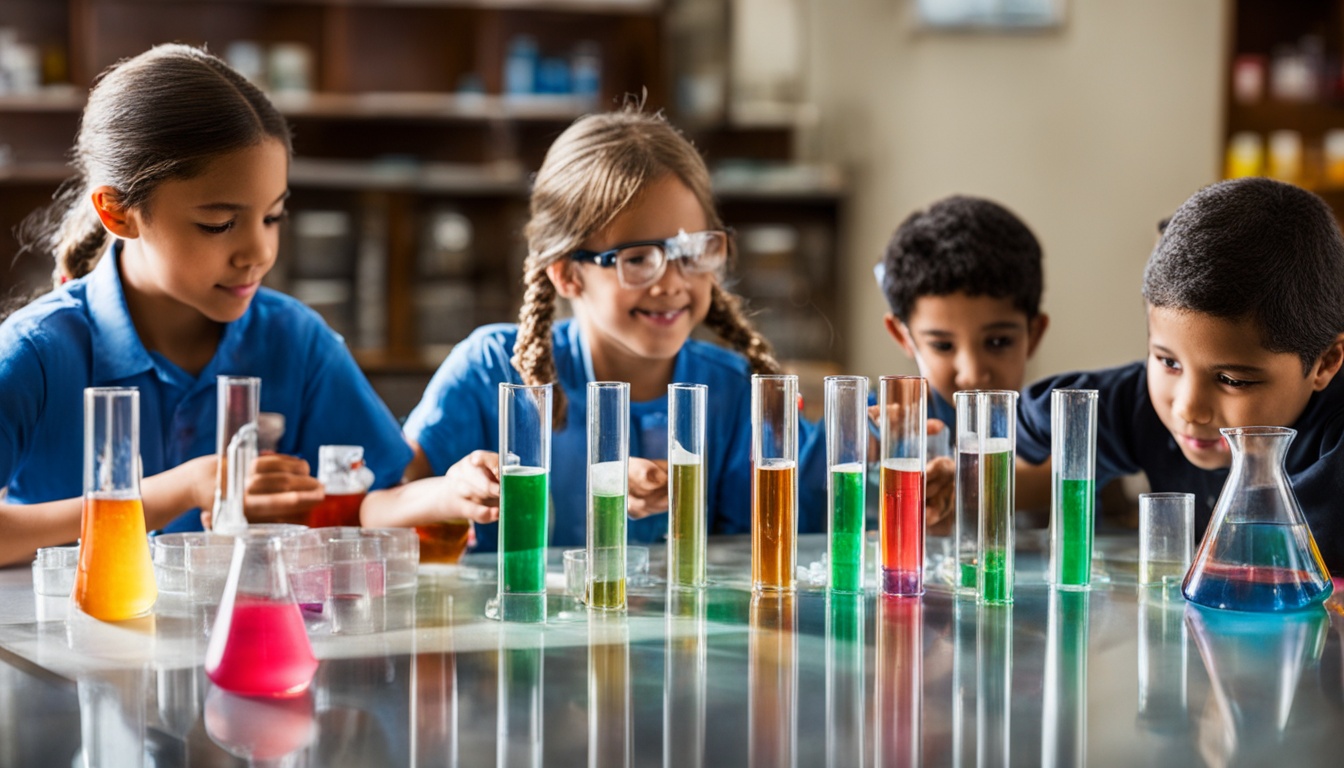
Exploring science is super exciting for kids! This article will show you 10 fun science activities that will make young minds curious and imaginative. Kids can make baking soda volcanoes or grow rainbows. These science activities for kids mix learning with fun.
If you’re a parent, teacher, or just someone who loves science, this guide is for you. It offers a variety of fun science experiments and interactive science projects that kids will love. Let kids become scientists by exploring the natural world with these hands-on science projects.
Exploring the Magic of Baking Soda Volcanoes
The baking soda volcano is a top pick for kids’ science experiments. It lets them see a cool chemical reaction and learn about volcanoes. You only need a few things from home to make your own volcano.
Materials Needed
You’ll need baking soda, white vinegar, a plastic container or bottle, and some food coloring or glitter. The container is your volcano’s base. The baking soda and vinegar make it erupt.
Step-by-Step Instructions
Start by putting the plastic container or bottle where you want your volcano. Add a few tablespoons of baking soda inside. Then, pour in some vinegar and watch the magic happen!
The baking soda and vinegar mix creates carbon dioxide gas. This gas makes the mixture bubble and spill over, just like a real volcano. You can change the size of the eruption by using more or less baking soda and vinegar.
For more fun, add food coloring or glitter to the mix. This makes the eruption look even cooler.
Educational Value
This experiment is not just fun; it teaches kids a lot. They learn about acids and bases, and the science of volcanoes. It’s a great way to make them curious about the world.
Growing a Rainbow with Celery and Food Coloring
Get ready to be amazed by the rainbow celery experiment! This fun science activity will capture your kids’ attention and teach them about capillary action in plants. By putting celery stalks in colored water, you’ll see the colored liquid move up the plant, making a beautiful rainbow.
This experiment is perfect for introducing kids to plant science. As the colored water goes up the celery, it shows how plants move water and nutrients around. It’s a great way to make learning fun and engaging, perfect for STEM projects.
To start, you’ll need celery stalks, food coloring, and water. Put the celery in containers with colored water. Watch as the colored water moves up the celery, creating a stunning rainbow. This shows how capillary action works in plants, moving fluids through their tissues.
This activity is great for sparking kids’ interest in science. It combines fun visuals with hands-on learning. Kids will love exploring plant science and how it supports life. Get ready to see the magic happen right before your eyes!
Building a Simple Circuit with Household Items
Building a simple electrical circuit with everyday items is a great way to teach kids about electricity. It’s a fun STEM activity that uses basic parts. This makes it perfect for kids and a great science project.
Required Materials
You’ll need a battery, a light source like a bulb or LED, and wires to make a simple circuit. You can find these items at home or at a hardware store. With these materials, you’re set to start your electricity experiment.
Circuit Assembly Guide
Start by attaching a wire to the positive battery terminal. Then, link the other wire end to the light source’s terminal. Use a second wire to connect the battery’s negative terminal to the light source’s other terminal. When done, the light should turn on, showing electricity is flowing.
This activity teaches kids about circuit basics and how conductors and insulators work. Seeing the light come on helps them understand complete circuits and the need for correct connections. This knowledge is a stepping stone to learning more about electronics and electrical engineering.

Experimenting with Milk Fireworks
Get ready to be amazed by a color-changing experiment with milk fireworks! This activity is a great way to make kids excited about science. By mixing milk, food coloring, and dish soap, you can create a show that looks like fireworks in a petri dish.
Ingredients and Supplies
You’ll need a few simple things for your milk fireworks: milk, food coloring, and dish soap. Collect these items and get ready for a fun science adventure!
Creating the Colorful Reaction
Begin by pouring a thin layer of milk into your container. Then, add a few drops of food coloring around the edges. Finally, put a small amount of dish soap in the milk’s center.
Watch as the food coloring spreads out, making a colorful, swirly pattern. It looks just like fireworks! This experiment is not only fun but also teaches kids about liquids, surface tension, and chemical reactions. It’s a perfect STEM project that mixes science, art, and magic.
Activities: Exploring the Wonders of Chromatography
Chromatography is a cool way to separate and identify what’s in a mix. Kids can try it out with a simple paper chromatography experiment. They’ll use coffee filters, markers, and water to see how pigments separate. This experiment is fun and teaches kids about chemistry and separating mixtures.
Materials Needed
To do paper chromatography, you need coffee filters, markers that dissolve in water, and a cup of water. This activity is a fun STEM project. It lets kids learn about separating colors.
Step-by-Step Process
Start by letting the kids pick a few markers and draw a dot on the coffee filter. Then, put the filter in the water cup, with the dot just above the water. The water will move up the filter, taking the pigments with it. This will show a beautiful display of colors.
Encourage the kids to watch and see how each color moves at its own pace. This color separation is amazing. It’s a great way to make kids curious about chemistry.
Constructing a Homemade Lava Lamp
Unleash your inner scientist and make a homemade lava lamp! This activity is both fun and educational for kids. It’s a great way to learn about density and chemical reactions. With oil, water, and a few simple items, you can make a lava lamp-like effect at home.

The magic happens because of the liquids’ different densities. The oil floats on top because it’s less dense than the water. Adding food coloring or glitter makes the denser liquid push these particles up. This creates a cool lava-like effect as they move up and down.
This experiment is not just fun; it teaches kids about fluid dynamics and chemistry. Watching the liquids mix, kids learn about buoyancy and immiscible fluids. This sets the stage for more science exploration in STEM fields.
Making your own lava lamp is a great way to spark curiosity in kids. It’s a fun way to introduce them to chemical reactions. Get ready to create a mesmerizing display and explore the secrets of the lava lamp!
Investigating Density with the Cartesian Diver
Explore the world of buoyancy and density with the classic Cartesian diver experiment. This fun science activity lets kids learn about density and how it changes how objects act in liquids. By making a “diver” with everyday stuff, kids see how density and pressure work together.
Materials Required
To make your own Cartesian diver, you’ll need a plastic bottle, water, and something small like a pen cap or clay. These simple things help create a fun STEM project that teaches and entertains.
Building the Diver
Start by filling the plastic bottle with water, leaving a small air pocket at the top. Put your chosen object, like a pen cap, into the water. See if it sinks or floats based on its density compared to the water. With some trial and error, you can make a diver that moves up and down in the bottle.
Observing Density in Action
When you squeeze the bottle sides, the Cartesian diver moves too. The air pocket in the diver gets smaller, making it denser and causing it to sink. Let go, and the diver goes back up, showing how buoyancy and density work. This activity is not just fun for kids but also teaches them important physics concepts.
Launching a Film Canister Rocket
Preparing a film canister rocket is a fun science activity for kids. It shows the power of chemical reactions and engineering. Kids mix vinegar and baking soda in a film canister. This makes a pressurized reaction that sends the “rocket” flying up.
This STEM project is not just fun. It teaches kids about design, chemical reactions, and physics. It shows how these ideas help rockets and other flying things work.
Supplies Needed
To make your own film canister rocket, you need a few things: a clean film canister, baking soda, vinegar, and fins made of paper or cardboard.
Rocket Construction Guide
Start by putting baking soda in the film canister. Then, add vinegar, leaving the lid a bit open. The baking soda and vinegar react, making gas. This gas will push the lid off and send the canister flying.
Add fins made of paper or cardboard for better stability. Place the canister on a flat surface, step back, and watch it soar!
This science activity for kids is both fun and educational. It teaches about engineering and chemical reactions. Kids learn about aerodynamics and design. They see how these ideas help objects move and stay stable.
Making Homemade Slime with Household Ingredients
Making homemade slime is a fun science activity for kids. It lets them play with non-Newtonian fluids. By using glue, borax, and food coloring, they can make their own slime. This project teaches them about slime’s unique behavior.
Slime acts like both a solid and a liquid, depending on how you touch it. This science activity for kids boosts creativity and teaches chemistry and material science. It’s a great way to learn through play.
Making homemade slime is both entertaining and educational. Kids see how the slime changes from a liquid to a stretchy solid. This hands-on activity helps them grasp slime’s special properties.
By doing this STEM project, kids learn about chemistry and material science. They get to see how slime reacts to different forces. It’s a fun way to spark their interest in science.
Crafting homemade slime is a great way to make kids curious about science. It’s a simple yet effective way to teach them about chemistry and materials. Let your young scientists explore the world of non-Newtonian fluids with homemade slime!