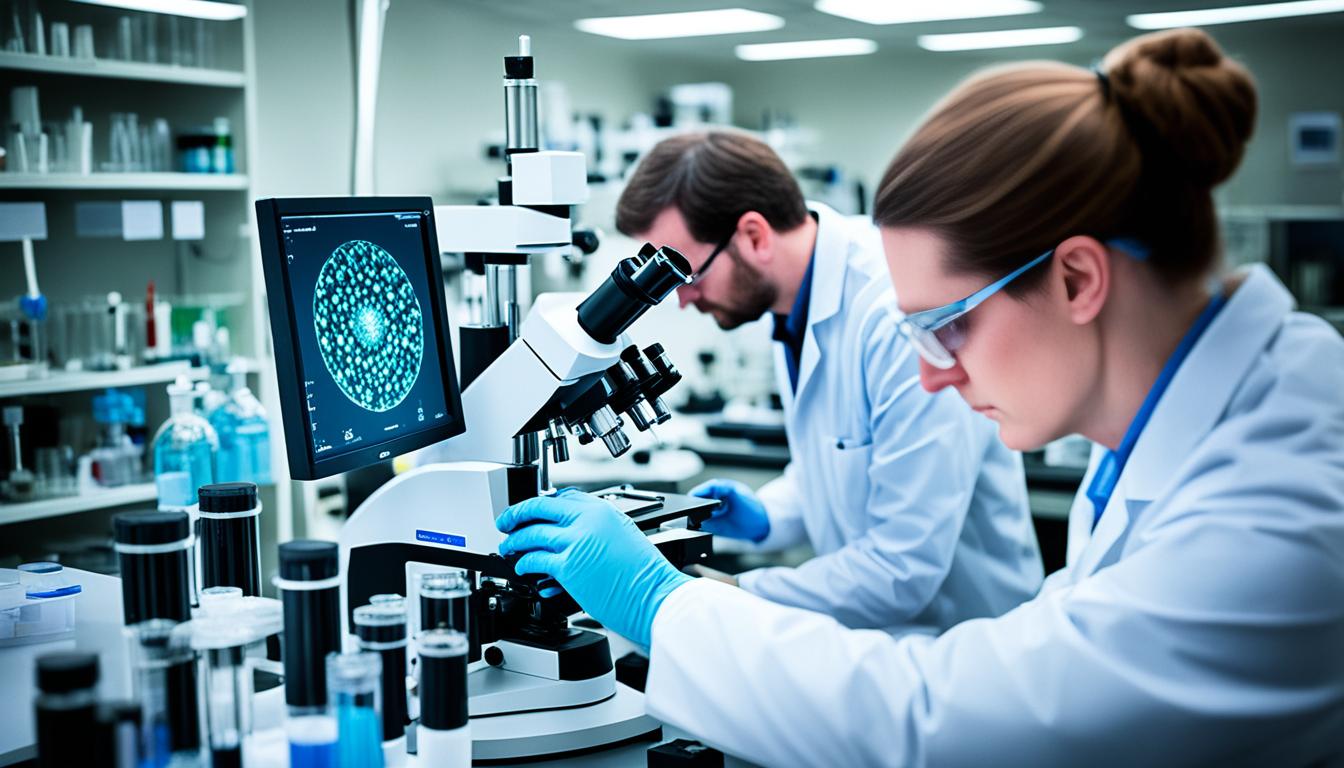
Scientific research is key to our progress, leading us to new discoveries and solutions. It drives the growth of knowledge and helps us understand our world better. This research is vital for solving mysteries and improving our lives.
It’s driven by a deep curiosity to explore the unknown. It helps us tackle big challenges and find answers. From understanding the universe to creating medical treatments, its impact is huge.
Scientific research leads to new ideas and breakthroughs. It helps us solve global issues and improve life quality. By constantly seeking knowledge, we push forward and make the future brighter.
Unveiling Nature’s Mysteries
The search for scientific discoveries is a constant journey of discovery and learning. By exploring the unknown, researchers uncover the secrets of nature. This expands our knowledge and understanding. From tiny particles to huge cosmic events, scientific research helps us appreciate the world more.
The Pursuit of Knowledge
Scientists are driven by a desire to learn more about the universe. They find new insights that challenge our old ideas and open new paths. Through careful experiments and observations, they solve the mysteries of nature, expanding what we know.
Expanding Horizons
Scientists keep pushing the limits of what we know. They uncover new possibilities by simplifying complex things. From the ocean depths to the atmosphere, and from the human body to the cosmos, each discovery broadens our knowledge. It also makes us curious, leading to more scientific progress.
Driving Innovation
Scientific research leads to big changes in our lives. It helps create life-saving treatments and new technologies. This research inspires us to think differently and solve complex problems.
Thanks to scientific research, many industries have changed for the better. For example, medical breakthroughs have improved our health and led to better treatments. Innovations in energy, transport, and communication have made our lives easier and greener.
Scientific research is great at solving tough problems with creative solutions. It lets us explore new possibilities and make progress. This shows how important it is to keep pushing the limits of what we know.
We’re always discovering new things in science, and this will lead to more big changes. Staying committed to scientific innovation means we keep solving problems and making life better. This keeps us moving forward as a society.
Enhancing Quality of Life
Scientific research greatly improves life for people and communities worldwide. It leads to new medical and tech breakthroughs. These changes are changing healthcare and making people’s lives better.
Medical Breakthroughs
Research has brought us new treatments and therapies. These can ease pain and help people live longer. Advances in surgery and personalized medicine are making a big difference. They’re helping many people live better lives.
Technological Advancements
Technology is also making life better, thanks to research. Things like assistive tech and digital health tools help people live on their own. They make it easier to manage health and keep living well.

Understanding Our World
Scientific research is key to understanding our planet’s complex systems. It helps us grasp the atmospheric processes and the balance in ecosystems. This knowledge is crucial for protecting the environment, fighting climate change, and managing natural resources sustainably.
Environmental Conservation
By studying the world around us, we learn about the web of life that supports us. This knowledge lets us create new ways to protect nature, save species, and deal with climate change. Using sustainable practices and technology, we aim to keep our environment balanced and strong.
Managing natural resources wisely is vital, and science helps us do it. Research in ecology, hydrology, and soil science gives us the tools to use resources carefully. This way, they’ll be there for both now and the future. Taking care of our resources is key to keeping the planet healthy for a long time.
Science: A Catalyst for Progress
Scientific research is a key driver of progress, changing societies and solving global problems. It helps us fight diseases and find new energy sources. This work makes the world a better place.
Science has helped us in many ways. Medical discoveries have saved many lives. Renewable energy has given us ways to fight climate change. By using science, we can keep making big improvements in life and society.
Science connects people all over the world. It helps us work together to solve big problems. By sharing research and working together, scientists are tackling issues like poverty and hunger. This work not only grows our knowledge but also helps society.
Looking ahead, science will be even more important. By encouraging curiosity and critical thinking, we can inspire others to use science to solve big problems. This will help us create a better future.
Fostering Critical Thinking
The scientific method is key to scientific research. It boosts critical thinking and problem-solving skills. It makes us curious, skeptical, and encourages making decisions based on evidence. These skills are vital for dealing with today’s complex issues.
The method starts with making hypotheses and designing experiments. It ends with drawing conclusions from data. This process teaches us to think critically, question our beliefs, and trust facts over feelings or biases. It helps us make smart, informed choices.

The Scientific Method
The scientific method is a step-by-step way to solve problems. It starts with spotting a problem or question. Then, a hypothesis is made, followed by experiments to test it.
After collecting and analyzing data, conclusions are drawn. These conclusions either support or challenge the initial ideas. This cycle of asking, testing, and evaluating is how science grows and knowledge increases.
Using the scientific method helps us value evidence and solve problems. These skills are crucial for both science and everyday life. They help us make better choices and participate in civic duties.
Shattering Boundaries
Scientific research often goes beyond old limits. Researchers from different fields work together to solve big problems. These interdisciplinary collaborations bring new ideas by mixing different views, methods, and skills. This leads to big discoveries that wouldn’t happen alone.
Breaking Down Barriers
By breaking down barriers, scientists use their special knowledge and skills to find new insights and innovative solutions. This teamwork lets them look at problems from many sides. This leads to a deeper understanding and better solutions.
Scientific collaboration has led to huge advances in health and the environment. It creates a space for open sharing and learning. This helps researchers push limits and make the world better.
Achieving Synergy
When experts from various fields work together, amazing things happen. They mix their unique views and skills to find solutions that one field alone couldn’t reach. This interdisciplinary research changes how we see complex issues and opens doors to a brighter future.
The Economic Impact
Scientific research is key to boosting economic growth and creating jobs. By investing in science and tech, countries can lead in the global market. This leads to big gains for the economy.
Research leads to new products and services that boost the economy and create jobs. From health breakthroughs to new tech, science changes industries and opens new markets.
Putting a focus on science keeps countries ahead in tech, making them more competitive. This ensures they do well over time. By supporting science and innovation, leaders can make their economies stronger.
Ethical Considerations
Scientific research is always pushing the limits of what we know and can do. It’s vital to think about the right and wrong sides of these advances. We must follow ethical rules, keep research honest, and make sure new discoveries help society in good ways.
Responsible Research
Doing ethical scientific research means always aiming for the highest standards. Researchers need to put people’s well-being first, avoid causing harm, and report their results truthfully. It’s key to have strong checks and clear decisions to keep the public trusting science.
Dealing with the ethics of research is complex. Researchers should talk often with policymakers, ethicists, and the public. This helps address concerns and create rules for responsible innovation. By focusing on ethics and promoting a responsible science culture, scientists can make progress without losing their integrity or impact on society.
Inspiring Future Generations
Science moves forward when we encourage the curiosity of the next generation. By sparking young minds with science, we help them see the value of STEM fields. This ensures a flow of new researchers and innovators who will keep expanding our knowledge and driving progress.
Science education is key to lighting the spark of curiosity in students. Through hands-on experiments and interactive learning, we can capture the imagination of tomorrow’s scientists. This approach helps students think critically, solve problems, and understand the world better.
Supporting STEM education benefits both students and the future of science. It gives them the tools, guidance, and chances to dive into scientific research. This way, we grow a diverse group of talented people who will lead innovation and expand our knowledge.
Creating a culture that values scientific exploration is vital for the next generation. By celebrating scientists’ achievements and the impact of their discoveries, we encourage everyone to embrace science. This builds a society that sees the worth of knowledge and scientific progress.
The Future of Scientific Research
Looking ahead, scientific research is on the brink of a big change. New technologies like artificial intelligence and quantum computing will change how we discover things. By working together, experts from different fields will tackle big challenges, leading to new discoveries.
Science’s future will focus on solving big problems like climate change, diseases, and finding new energy sources. By combining different areas of study, scientists can look at problems from many angles. This will lead to new solutions that will change our world. Researchers from all over will work together, creating a global team focused on progress.
New technologies will play a huge part in this future. Artificial intelligence and machine learning will make analyzing data and coming up with ideas faster. Quantum computing will let us simulate complex systems on a huge scale, opening up new areas to explore. When these techs meet traditional science, research will become faster, more precise, and deeper.