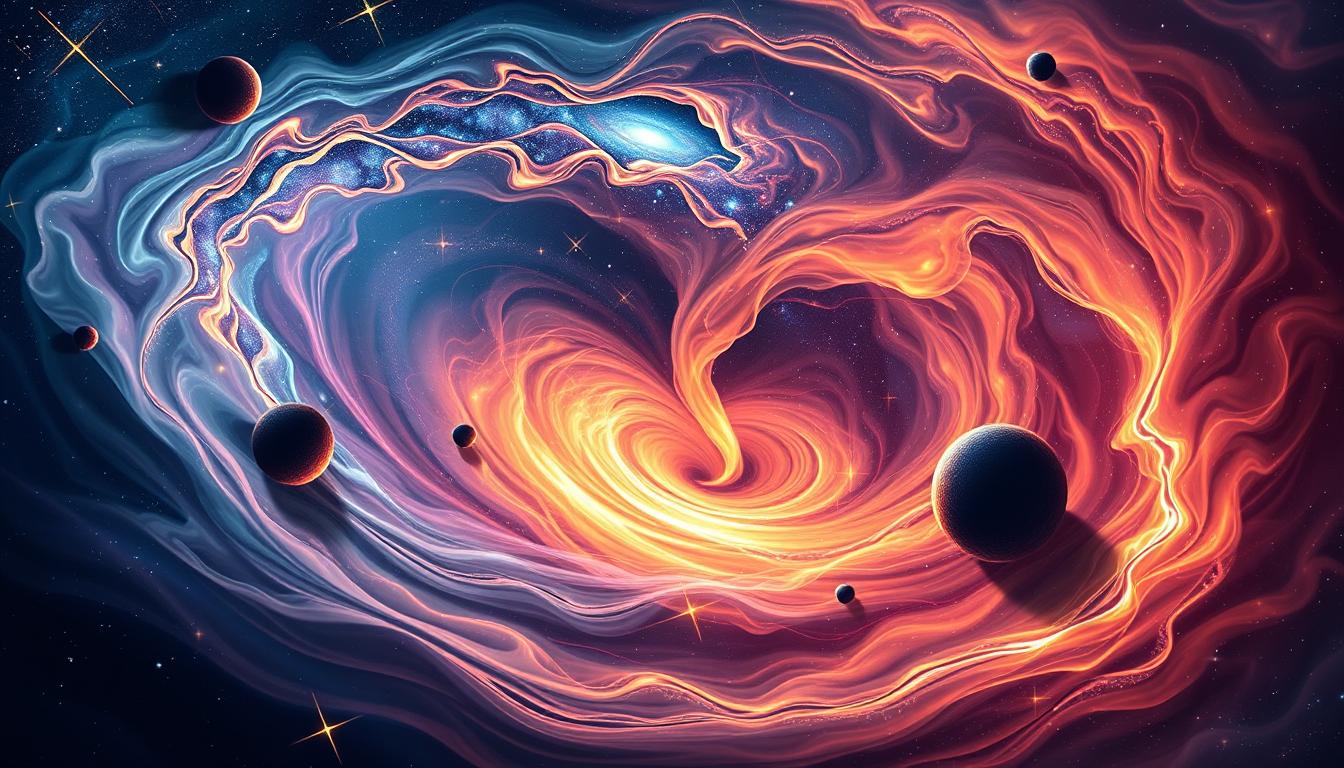
Step into the world of space-time, where the universe’s secrets are revealed. We’ll explore Albert Einstein’s groundbreaking ideas. These ideas changed how we see the cosmos. Get ready to see the universe in a new light.
Einstein’s theories, like the space-time continuum, have changed how we understand reality. We’ll dive into these ideas. This will help us understand the universe’s mysteries that have puzzled scientists and philosophers for years.
Join us on this exciting journey through space-time. We’ll explore new ideas and uncover the universe’s secrets. Be amazed and inspired as we dive into Einstein’s theories and their impact on our world.
The Concept of Space-Time: A Brief Overview
Space-time is a key idea in modern physics. It looks at how space and time are connected. Albert Einstein’s work changed how we see the universe and its structure.
Imagine space-time as a four-dimensional fabric. It combines the three dimensions we know (length, width, height) with time. This cosmic tapestry is the base of our universe, guiding how things and events interact.
The idea of Space-Time shows that space and time are not separate. They are deeply connected. This idea changes how we see the world, from tiny particles to the universe’s growth.
Exploring space-time helps us understand the universe’s beauty and complexity. It prepares us for new theories and discoveries in the cosmos.
Einstein’s Revolutionary Ideas
Albert Einstein’s theories of Relativity changed how we see the Spacetime Continuum. His work challenged old ideas in physics that had been around for centuries. His Special Theory of Relativity, introduced in 1905, showed that physics is the same for everyone moving at the same speed. It also said that light always travels at the same speed, no matter how fast you’re moving.
In 1915, Einstein’s General Theory of Relativity went even further. It said that Gravity is not a force, but a result of Spacetime bending around massive objects. This idea changed how we understand the universe. It showed that big objects like stars and galaxies can bend Spacetime, affecting how other objects move.

Einstein’s ideas have deeply influenced our view of the universe. They have helped us understand Gravity and the universe’s origins. His work has also led to new discoveries in physics and cosmology. It has opened doors to understanding quantum mechanics and finding a unified theory of nature’s forces.
The Fabric of the Universe: Space vs. Time
The connection between space and time is key to understanding our universe. Einstein’s groundbreaking ideas showed how these two are closely linked. They form the Cosmic Choreography that shapes our universe.
Space and time are not separate things. They are two sides of the same coin, the Spacetime Continuum. Our view of the world is influenced by how space and time interact. The way space curves, as Einstein said, is what we feel as gravity. This curve is changed by the presence of matter and energy.
Grasping how space and time are connected is vital for understanding the cosmos. By exploring this Dimensional Fabric, scientists uncover the universe’s secrets. They learn about the forces and structures that guide our universe’s dance.
Time Dilation: Understanding the Phenomenon
Albert Einstein’s theory of relativity introduced a fascinating concept called time dilation. It shows that time can move differently for fast-moving objects or those in strong gravity. This idea is part of Einstein’s Cosmic Choreography, which explains how Space-Time works.
The 1971 Hafele-Keating experiment is a key example of time dilation. It involved flying atomic clocks around the world. When compared to a clock that didn’t move, the flying clocks were slightly off. This confirmed Einstein’s predictions about time’s relativity.
Time dilation has big effects, like helping GPS systems work right and studying black holes. It also helps us understand how the universe expands. This phenomenon keeps showing us how deep and complex the universe is, thanks to Einstein’s insights.
Black Holes and Their Relationship to Space-Time
Gravity is a key force in the universe, shaping the Spacetime Continuum. At its core are black holes, objects so dense that light can’t escape. These mysterious beings deeply affect space-time’s structure.
Black holes form when a massive star collapses. This creates a singularity, where physics as we know it fails. The star’s matter is squeezed into an infinitely small space. This makes the black hole’s gravity so strong that it warps space-time, trapping everything near.
This warping of space-time has big effects on time and space. Near the event horizon, time seems to slow down. The fabric of reality gets distorted. This phenomenon, called time dilation, is a key part of black hole research.
The Expansion of the Universe
The universe is always changing, like a grand dance. At its core, the discovery of the universe’s expansion is key. This idea was first suggested by Edwin Hubble in the 1920s. It has changed how we see the universe.
The force behind this expansion is dark energy. It spreads across the universe, pushing galaxies apart. This creates a cosmic dance, showing the universe’s amazing complexity.

This expansion changes how we see Space-Time and the universe’s future. As it speeds up, the universe might change a lot. Scientists are working hard to understand this, trying to grasp the universe’s secrets.
Time Travel: Science Fiction or Possibility?
Time travel has always fascinated us, mixing science and fiction. In space-time theory, it’s a topic of debate. Wormholes and closed timelike curves are just a few ideas that excite both scientists and the public.
Einstein’s work on space-time laid the groundwork for time travel. It shows how space and time are connected. But, the challenges and paradoxes make many question if it’s possible.
Even though time travel sounds like science fiction, scientists keep exploring it. Wormholes could be a way to travel through space-time. But, making them stable and usable is a big problem.
As we learn more about space-time, time travel stays a topic of debate. It raises many questions, both practical and philosophical. Whether it happens or not, studying time travel helps us understand the universe better.
Quantum Mechanics and Space-Time
Quantum Mechanics explores the strange world of tiny particles. It challenges classical physics with its weird rules. In this world, particles can act like waves and be in many places at once.
This quantum world is connected to our universe’s fabric. Phenomena like quantum entanglement, where particles affect each other far apart, puzzle us. They make us rethink space and time.

Exploring Quantum Mechanics pushes us to rethink our universe. The mix of quantum and space-time is a big research area. Scientists aim to find a way to connect these two worlds.
The Role of Space-Time in Cosmology
Space-time has changed how we see the universe. Einstein’s work merged space and time, leading to a deeper understanding of the cosmos. This Dimensional Fabric of Space-Time is key to our universe models.
The Big Bang theory depends on space-time. It explains the universe’s initial expansion and the cosmic microwave background radiation. It also helps us understand galaxies, dark matter, and dark energy.
Exploring Space-Time in Cosmology reveals the universe’s intricate dance. This knowledge satisfies our curiosity and helps us uncover the universe’s secrets. It guides us in making new discoveries.
Practical Applications of Space-Time Theory
Space-time theory may seem complex, but it has real-world uses. For example, the Global Positioning System (GPS) uses it to guide us. This system is key for finding our way and tracking things.
GPS satellites orbit the Earth and must adjust for time dilation. This is because they move fast and are in a weaker gravitational field. By fixing these issues, GPS gives us the exact location we need for daily tasks.

In the future, space-time theory will help with space travel. It will guide astronauts and spacecraft through space. It also helps scientists study Gravitational Waves, revealing secrets of the universe.
Future Discoveries and Theories
Scientists are on the brink of making groundbreaking discoveries. They aim to merge quantum mechanics and general relativity into one theory. This could reveal the universe’s deepest secrets.
Wormholes and higher dimensions are sparking new research. The idea of a multiverse, where our universe is just one part, is mind-bending. These ideas challenge our understanding of reality and could change physics forever.
Researchers face many challenges, but their commitment is unwavering. They are exploring the quantum world and the universe’s structure. The future holds exciting possibilities for understanding space-time and our place in the universe.